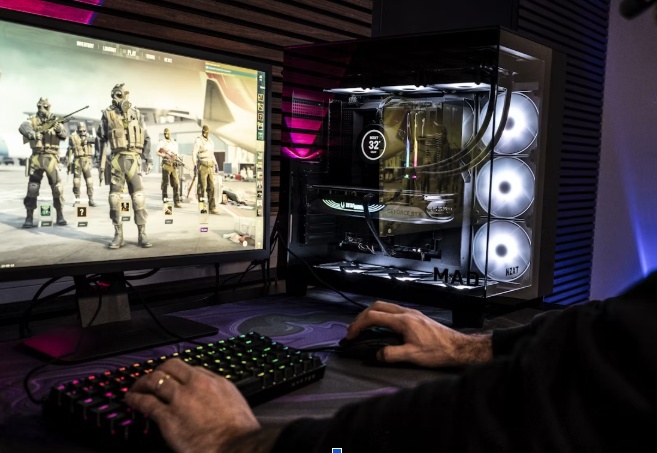
Every time you switch games, you feel like a complete beginner again. Your aim feels off, you keep dying in stupid spots, and players who’ve been there longer just run circles around you.
Here’s the thing nobody tells you: the skills that make someone genuinely good at Valorant are almost identical to what makes someone dangerous in Warzone, Tarkov, or Apex. The games look different. The fundamentals don’t.
This guide breaks down those fundamentals—and how to actually build them across every title you play.
The Universal Language of Competitive Games
Researchers studying esports athletes across different genres keep finding the same thing. High-level players converge on nearly identical cognitive patterns regardless of what game they play—anticipation, threat prioritization, efficient decision-making under pressure.
That’s not a coincidence. It’s because almost every competitive game rewards the same core set of skills.
Aim and input control. Situational awareness. Positioning. Resource management. And composure when things go sideways.
Master those in one game and you’ve built a foundation that transfers almost immediately. The games just express those skills differently.
Technical Mechanics You Can Actually Transfer
Sensitivity and Crosshair Placement
Most players jump into a new game and immediately fiddle with sensitivity until something “feels right.” That’s backwards.
Serious players standardize on a single cm/360 measurement and convert it across titles. The logic is simple—your muscle memory for precise micro-corrections is built at a specific sensitivity. Constantly changing it rebuilds that memory from scratch every time.
Pick a low-to-medium sensitivity. Stick with it. Let the consistency compound.
Crosshair placement is the other half of this equation, and the guidance is almost word-for-word identical whether you’re reading a CS2 guide or a Warzone breakdown. Hold head height relative to the terrain. Pre-aim where enemies are likely to appear. Cut your mouse movement down to a micro-adjustment rather than a full swing.
Do this well in Valorant and it instantly carries into CoD, Apex, and Rainbow Six. The angles change. The principle doesn’t.
Recoil Control and Tracking
Recoil patterns are learnable, repeatable skills. The progression is the same across every shooter—single-shot precision first, then controlled bursts, then full spray management.
Tracking drills, where you stay locked onto a moving target while you’re also moving, translate directly into CoD, Apex, and Overwatch 2. Sustained damage and fast target switching matter in all of them. The drill you do on one title sharpens you on every other.
Tools like game cheats with carefully configured aim assistance—moderate FOV, high smoothness settings—can reinforce these patterns by letting you focus on crosshair placement and macro decisions rather than raw micro-aim mechanics during the learning phase.
Positioning, Peeking, and Surviving Fights
Tactical shooters like CS2 and Valorant have essentially formalized the vocabulary for positioning that every other genre uses informally.
Off-angles to catch enemies off guard. Jiggle peeks to gather information without full exposure. Shoulder peeks to bait shots. Never re-peeking the same angle after being spotted—because now they’re pre-aimed right where you were.
These aren’t CS2 concepts. They’re geometry concepts. And they apply everywhere.
In Tarkov, experienced players use jiggle peeking around chokepoints in exactly the same situations a Valorant pro would on a tight corner. In Warzone and Apex, the same logic shows up as “peek with advantage”—using elevation, cover timing, and head glitches so you see the enemy first while exposing less of your hitbox.
Learn the vocabulary in one tactical shooter and you have a mental model that works across every title you’ll ever play.
Information Is Power—In Every Game
High-level players consistently describe positioning, information, and timing as the actual win conditions of any competitive game. Aim just lets you cash them in.
Reading a minimap—triangulating where enemies are, predicting their rotations, understanding lines of sight—is a universal skill. Valorant’s radar and CS2’s mid-round callout logic translate directly into Warzone UAV reads, Apex ring rotation predictions, and Tarkov sound-based threat detection.
ESP and radar hacks accelerate this learning curve considerably. Instead of spending hundreds of hours slowly building intuition about where enemies tend to appear, you’re seeing the information layer directly. Common routes, typical timing windows, frequent flank paths—all of it becomes visible. That pattern recognition sticks even when you’re playing without assistance, because you’ve seen the map from a completely different perspective.
The key is using these information tools to reinforce good positioning habits rather than replacing the thinking entirely.
Economy and Resource Management
This is the skill gap that separates good players from great ones, and it barely gets discussed in most beginner guides.
In Valorant and CS2, understanding when to save weapons, when to force-buy, and how to plan around your team’s economy matters more than individual duels in a huge percentage of rounds. Players who grasp this at a deep level gain a structural advantage that mechanical aim can’t overcome.
The same mental model runs through every other genre:
- In Tarkov, it’s evaluating loot value versus slot efficiency, planning extraction routes that balance risk against reward, and knowing when a fight isn’t worth the gear loss.
- In Warzone and Apex, it shows up as rotation decisions—taking position early instead of fighting for every kill, conserving resources for end-game scenarios where your position is strong.
Conserve when the odds are against you. Invest heavily when position, timing, or economy gives you the advantage. That principle doesn’t care what game you’re playing.
Game-by-Game: How the Framework Plugs In
Call of Duty (Warzone, MW3, BO6)
Warzone rewards tracking aim, aggressive repositioning, and rotation decisions based on zone movement and intel. The players who win consistently aren’t the ones with the highest aim—they’re the ones who understand map flow and fight selection. Tracking practice in Warzone directly improves dueling in Apex and Overwatch 2, while spawn knowledge and map flow sharpen rotation instincts in Fortnite and Rust PvP.
Escape From Tarkov
Tarkov is fundamentally about information, risk tolerance, and survival timing. Map mastery, sound discipline, knowing which fights to skip entirely—these habits build a risk-assessment mindset that immediately improves end-game decision-making in any battle royale. The player who survives Tarkov raids learns when not to fight in a way that most BR players never fully develop.
Rainbow Six Siege
R6 Siege is a masterclass in pre-round planning. Operator synergy, vertical map control, utility timing, and crossfire creation—all of it transfers cleanly into CS2 bombsite setups, Valorant defensive structures, and Overwatch 2 team fight coordination. If you understand R6 site defense at a conceptual level, setting up a CS2 B-site feels immediately familiar.
Valorant, CS2, Overwatch 2
These three titles emphasize economy, utility timing, and strict mechanical discipline more than almost any other competitive games. Players who develop real crosshair placement habits here often notice immediate improvement across every other shooter they pick up. The discipline required—no ego-peeking, respecting utility, trading kills—is the hardest habit to build and the most transferable once you have it.
Apex, Fortnite, Rust
Third-party management, zone rotations, and fight selection are the defining skills here. Smart players resist obvious engagements and instead clean up weakened squads from advantageous positions. In Rust, the same mindset extends to base placement and off-peak farming as forms of positional economy.
Tracking Progress That Actually Means Something
Generic rank improvement is a bad metric for cross-genre development. The stats that actually signal skill growth are smaller and more specific.
Headshot percentage and accuracy trends in CS2 and Valorant. Entry success rate and trading efficiency in round-based games. Extraction rate and loot value per raid in Tarkov. Damage-per-game and fight selection quality in Apex and Warzone.
Pick one specific metric per game, track it over 20-30 sessions, and change one variable at a time—sensitivity, crosshair placement habit, positioning choice. That’s the same QA approach that serious players and tool providers like Battlelog.co both use, and it’s the fastest path to understanding what’s actually limiting your performance.
The Bottom Line
Jumping between games doesn’t mean starting over. It means applying a tested framework to a new set of rules. Sensitivity consistency, crosshair discipline, positioning logic, and economic thinking—these fundamentals built in one game compound into every other title you touch.
The players who develop these skills deliberately, across multiple titles, with the right tools and honest performance tracking, are the ones who feel competent almost immediately in any competitive game they pick up.
That’s the actual edge. Not raw aim. Not hours logged. A transferable system that keeps working wherever you take it.
WAARDEER DIT ARTIKEL!
Als je dit artikel waardeert en je waardering wilt laten blijken met een kleine bijdrage, dan kan dat. Zo help je onafhankelijke mediajournalistiek in stand houden.